Orain Models · Train your own classifier
Train a classifier on your own slides. See how good it is before you trust it.
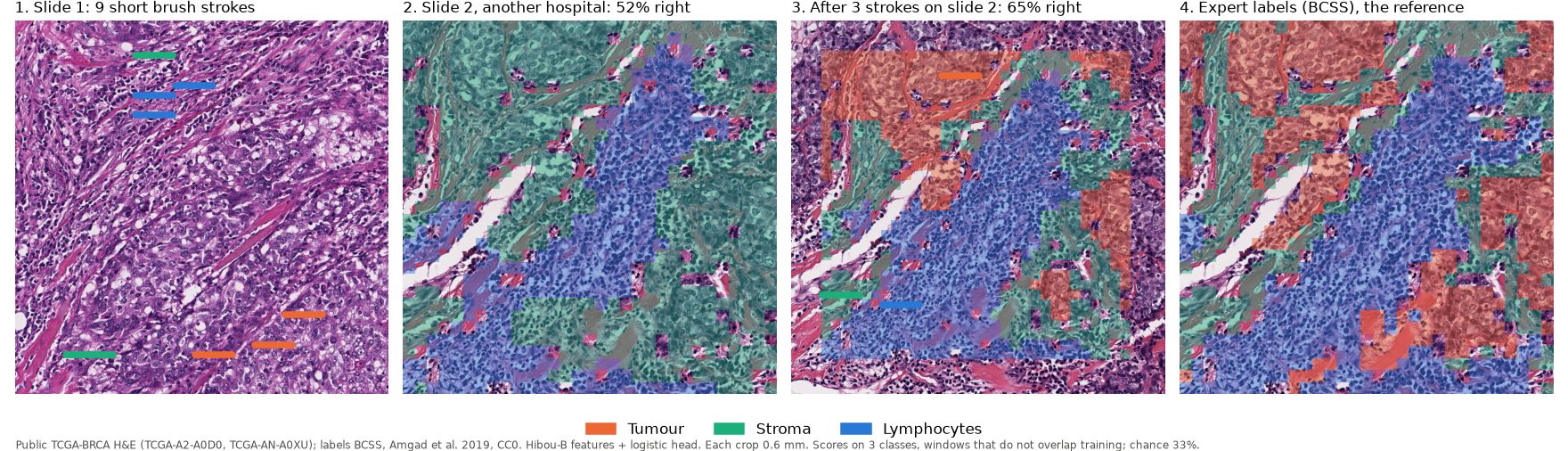
Paint a few examples with the brush or import your QuPath annotations. Orain trains on pathology foundation-model features of your slides, scores the model on tissue it did not train on, and shows you where it is wrong, so the next examples go where they help.
Who it is for
Pathologists and scientists
You know the tissue; you do not need to write code or own a GPU.
QuPath users
Bring the annotations you already have as GeoJSON; the classes come with them.
Teams that must show it works
Every model reports how it does on tissue it never saw, per class, and ships with a model card.
Four steps
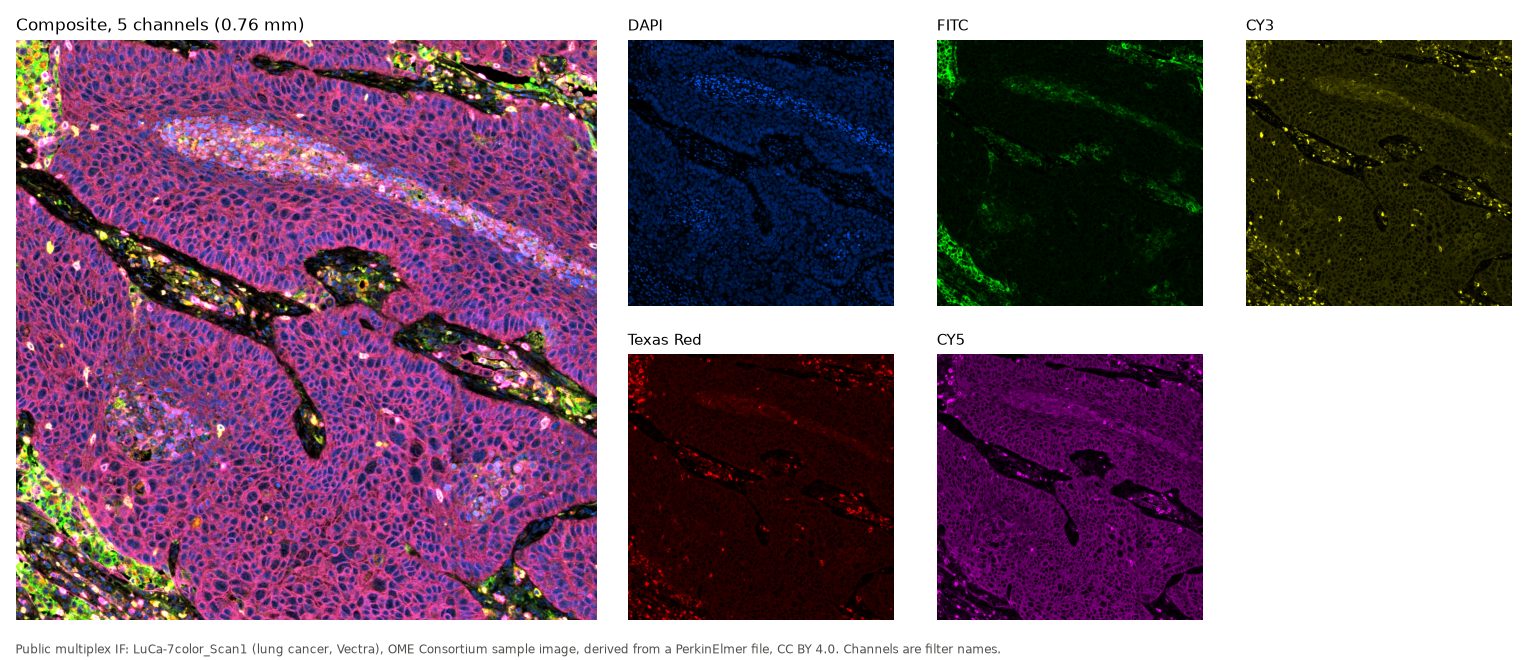
- Show it examples. Paint a few regions per class on your slides with the brush in the viewer, or import your QuPath GeoJSON annotations. This works on H&E, IHC and multiplex IF slides once their patch features are computed.
- Orain trains and tells you how good it is. A classifier learns from pathology foundation-model features of your slides and reports its accuracy, per class, on parts of the slide it did not train on, and on whole slides it did not train on when you give it several.
- Correct it. Orain shows you a check set of patches, half picked at random and half where it is least sure; your answers go into the next round.
- Run it on every slide. Each slide gets a map in the viewer and a row of numbers per slide or region, as CSV. Your annotations export to QuPath as GeoJSON, and the model as a bundle with its labels, predictions and a Python predict script.
How many examples
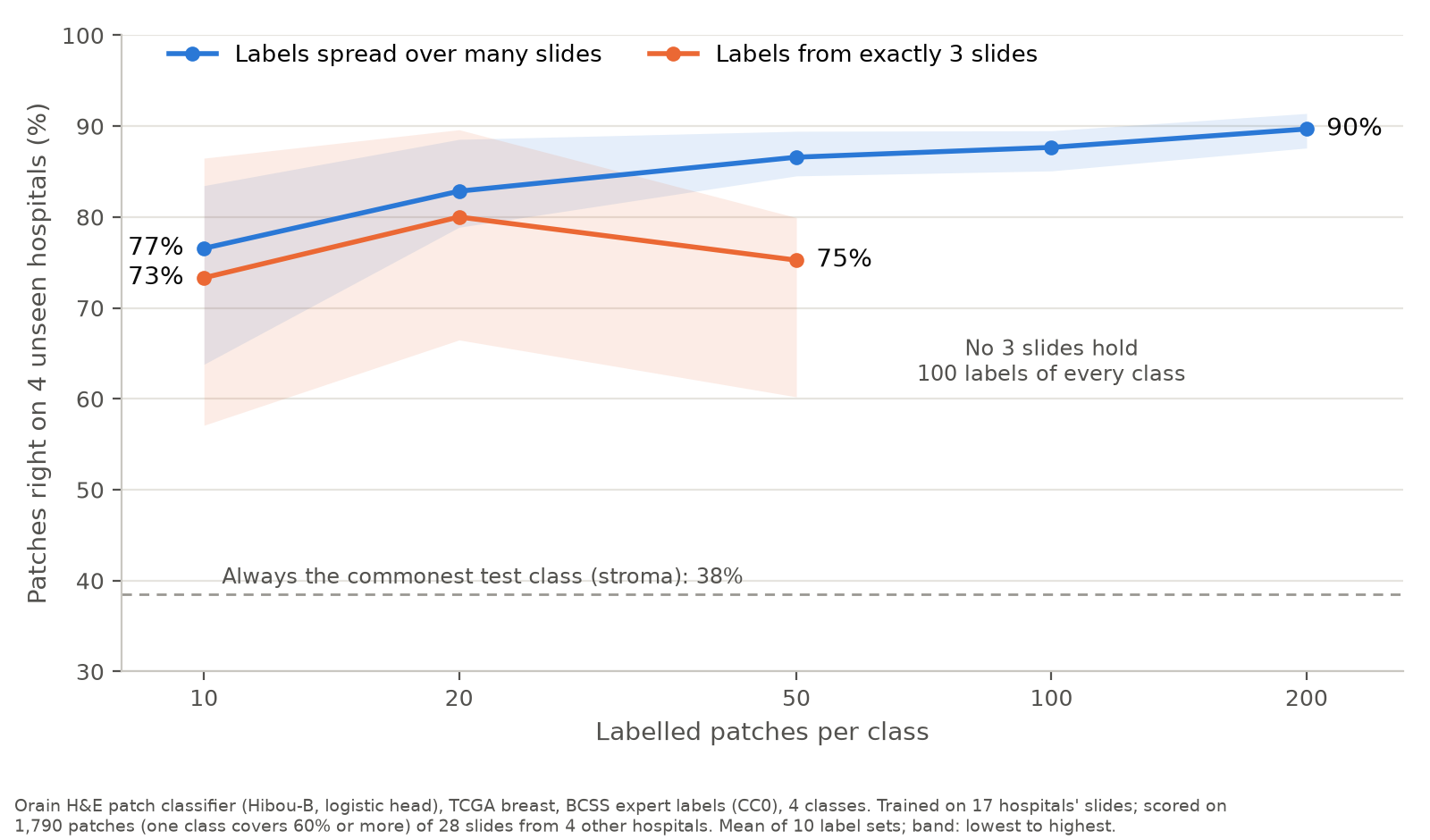
Spread your examples over many slides. On four breast-cancer hospitals the model never saw, labels spread over many slides gave 77% of patches right with 10 labels per class, 87% with 50 and 90% with 200. The same counts from exactly 3 slides gave 73%, 80% and 75%, and varied far more with the slides chosen (57% to 90%); no 3 slides held 100 labels of every class.
One flow for every stain
H&E and IHC
Tissue classes from regions you draw, on the slide's foundation-model patch features; cell classes from points you place on cells, on each cell's measurements.
Multiplex IF and imaging mass cytometry
Regions on the slide's multiplex patch features, or points on cells read through each cell's marker values, alongside marker gating and phenotypes.
What is different
A number on tissue it did not see
The score is measured on parts of the slide, and whole slides, that the model did not train on, per class, beside what always guessing the commonest class would score.
The failure shown
Orain picks the next patches to check: half at random, half where the model is least sure. Your answers go into the next round.
QuPath in and out
Import QuPath GeoJSON as labels; export your annotations as GeoJSON and the model as a bundle with its labels, predictions, a model card and a Python predict script.
From chat or Claude
Ask in a sentence (“train a tumour/stroma classifier on these slides from my regions”) and Orain's analyst runs the same steps in your project.
Free to start
A free account comes with $5 of credit. Compute, storage and chat charge at provider cost plus 50%; there is no subscription and no demo call.
For a model you will publish or sell: ask Orain to set up a reader study. Several pathologists read the same patches blind in the review panel; Orain reports their agreement (Fleiss' kappa) and sends the disputed patches to an adjudicator.
Questions
How many examples do I need?
Training starts at 10 labelled patches or cells per class. What matters more is how many slides they come from: on unseen hospitals, 50 labels per class spread over many slides gave 87% of tissue patches right, and 50 from exactly 3 slides gave 75%, with results from 60% to 80% depending on the slides. Paint a few strokes on each of many slides, then check the patches Orain picks and train again.
Is any image sent to an outside AI model?
Not when you train from your own regions or points: the labels are your drawings, and the model trains on Orain's servers.
Do my slides train the Orain models?
No. Your slides and labels never enter the Orain models or the atlases without your written consent. A classifier you train stays in your workspace.
Can I use it for diagnosis?
No. It is for research use only and is not a diagnostic device.